Preserving the Personal Touch: How AI Operating Systems Are Reducing Funeral Director Burnout
The death care industry relies on a profound, deeply empathetic human element that cannot be replicated by algorithms. However, behind the quiet visitations and supportive embraces, funeral directors carry an incredibly heavy, round-the-clock administrative burden. From coordinating transportation logistics and state permitting to managing vendor invoices and organizing family details, the modern mortuary professional frequently operates in a state of chronic operational fatigue. Fortunately, a quiet tech revolution is sweeping through the trade, driven by artificial intelligence and specialized management software. Instead of replacing the director’s role, these digital tools are taking over repetitive tasks, freeing up professionals to give their undivided attention to grieving families.
The primary advantage of introducing AI and automated systems into funeral home management is the rapid elimination of backend data duplication. Historically, a director would manually transcribe a decedent's information across half a dozen distinct forms, registry books, billing software, and web portals. Modern all-in-one funeral operating systems seamlessly bypass this friction by functioning as a centralized brain. When a family submits initial data through a secure portal, the system automatically auto-populates case tracking workflows, maps out service timetables, coordinates with florists, and drafts basic digital documents. A workflow that used to consume hours of tedious data entry is compressed into a few clicks, drastically lessening the administrative friction that leads to workforce burnout.
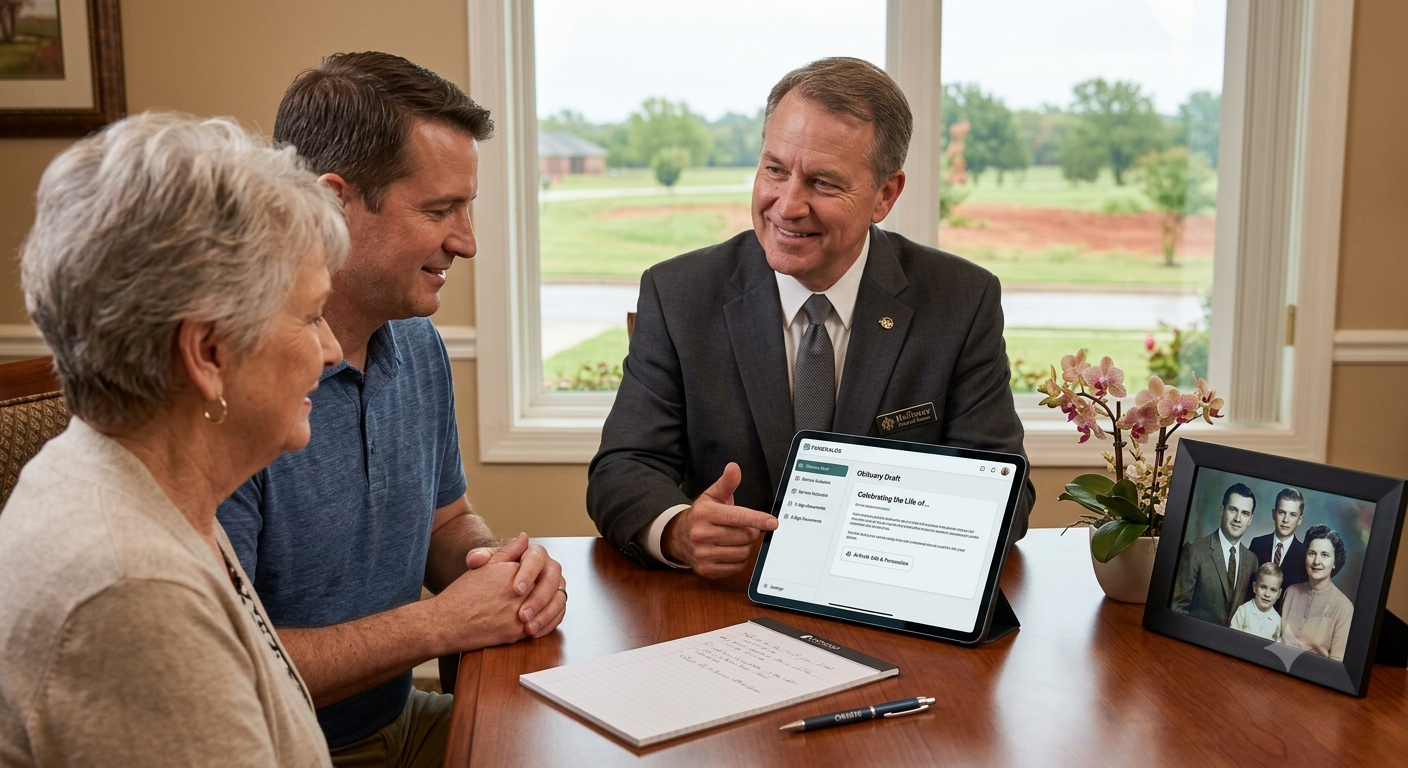
This technological evolution is heavily apparent across Oklahoma, where forward-thinking death care professionals are embracing digital tools to soften the burdens placed on grieving families. For example, local establishments like Holloway Funeral Home have introduced AI-driven obituary writing tools to their suite of services. During the intense fog of early grief, trying to sit down and compose a comprehensive, beautifully structured tribute can feel completely paralyzing for a family. By utilizing an AI co-pilot that synthesizes key dates, relationship milestones, and personal anecdotes, the software generates a dignified, highly accurate starting draft in seconds—allowing families and directors to collaborate on the final polish without the initial creative strain.
Furthermore, Oklahoma's connection to death care innovation runs deep, with some of the industry's premier backend organizational platforms originating right within the Sooner State. Widely utilized tools like Osiris Software, independently developed out of Northwest Oklahoma by funeral directors themselves, have transformed how firms track their operational health. While not a sentient AI, platforms like Osiris provide the critical digital framework—such as cloud-based document storage, automated e-signatures, and instant multi-department data distribution—that modern AI plugins rely upon to operate smoothly. By keeping case management perfectly synchronized from any mobile device, local directors can step away from their physical desks without losing control of their active service logistics.
The business impact of shedding this operational weight directly addresses the relentless "always-on" nature of the death care profession. AI-driven website assistants and dynamic form filtration systems now handle the influx of late-night, routine digital inquiries regarding baseline pricing or general directions, screening out online spam and ensuring that directors aren't constantly woken up by non-emergencies. Back-office scheduling AI can dynamically map out staff rotations and vehicle usage, reducing the chaos of managing overlapping services. The end result is a noticeable improvement in the quality of life for the staff, translating to a more centered, emotionally available presence when they are actively sitting down with a client.
Ultimately, the rise of artificial intelligence and cloud-based automation in the funeral industry is not an attempt to sanitize an intensely personal milestone with cold code. Rather, it acts as a digital shield against burnout, taking over the mechanical, redundant parts of running a business so the human staff doesn't have to sacrifice their own mental well-being to keep up. In a field where compassion is the primary service being rendered, delegating the paperwork to intelligent software ensures that Oklahoma's funeral professionals can keep their focus exactly where it belongs: guiding communities through their darkest hours with unwavering grace.